Rescue The Lover
- 4.6
- Rating
- 50.00M
- Installs
- Free
- Price

 Analysis by App-foxy
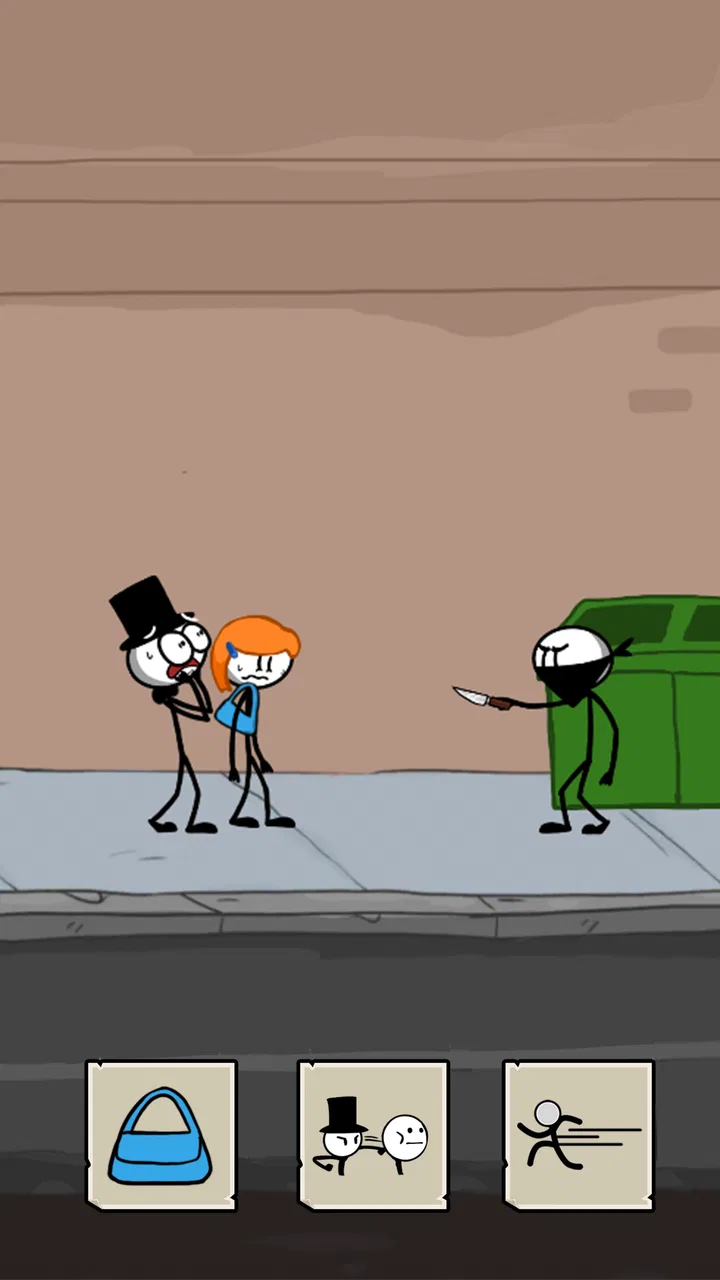
I went into Rescue The Lover expecting a quick, disposable adventure game, and that first impression is mostly accurate—but not in a bad way. It is a light, situation-based game from ABI Games Studio in which a stickman faces dangerous moments and you decide what he should do next while he tries to save the person he loves. The appeal is immediate: each scene presents a small problem, the choices are easy to understand, and the result usually arrives quickly.
What makes it worth discussing is not whether it can fill an entire weekend with deep exploration. It cannot. The better question is whether its short decision-making loop earns a place on your phone after the novelty wears off. In my experience, it works best as a casual break between other activities. I could open it when I had only a few minutes, make progress without preparing for a complicated session, and put it down without losing the thread.
The game is free and aimed at Everyone, which fits its simple presentation and accessible premise. It belongs to the adventure category, but it is much closer to a sequence of compact choices than to a traditional adventure with a large map, inventory management, or long conversations. That distinction matters if you are deciding between this and a more substantial story game.
You May Also Like

 AccuWeather: Weather Radar
AccuWeather Review: A Quick, Clear Forecast for Everyday Decisions
For everyday plans, the best forecast is the one you can understand quickly. AccuWeather makes rain timing, radar, and local conditions easy to act on, with a few trade-offs.

 Hill Climb Racing
Why Hill Climb Racing Still Turns Crashes Into One More Run
A tiny car, a bumpy hill and one more upgrade: Hill Climb Racing keeps resurfacing because its simple chaos makes every near-miss feel personal.

 AliExpress - Shopping App
AliExpress Makes Global Shopping Feel Personal, but Shoppers Bear the Risk
AliExpress turns a global marketplace into a pocket-sized discovery engine. Its reach is useful, its shopping loop compelling, and its trade-offs easy to miss.

 Lords Mobile: Kingdom Wars
Lords Mobile Is a Kingdom-Building Routine, Not a Quick Match
A case-by-case verdict on the building, battles, device demands, and social commitments that make Lords Mobile rewarding for some players and exhausting for others.

 PDF Scanner app - TapScanner
TapScanner Makes Paperwork Easier to Capture, Check, and Share
TapScanner makes scanning with a phone feel less like a rescue operation and more like a dependable step in getting work done. Its capture tools are useful, though not flawless.

 Block Blast!
 Shows How Much a Puzzle Game Can Leave Out
A quiet grid game shows why puzzle players increasingly value instant clarity, repeatable skill and low-pressure play—and where the genre still needs to catch up.
More From Our News Desk
View All News


What the first week feels like
I found the first week is less about building a routine and more about learning whether the quick choice-and-outcome rhythm fits the little gaps in your day. I’d pay attention to whether I’m enjoying the decisions themselves, not just the novelty of seeing what happens; that distinction helps set a fair expectation for its staying power.
Simple choices make the opening easy to enter
The central interaction is straightforward: a stickman arrives at a risky situation, and I choose between the available actions. The challenge comes from judging the scene rather than mastering fast controls. That makes the opening especially friendly to players who do not want a tutorial-heavy experience. You can understand the basic rhythm almost immediately, even if you are not someone who normally plays adventure games.
The rescue theme gives the choices a clear purpose. I am not selecting actions without context; I am trying to move the character closer to his lover while avoiding the consequences of a bad decision. That small emotional goal helps the individual scenes feel connected. It is a modest story framework, but it is enough to make the next situation feel more meaningful than a completely abstract puzzle.
During the first sessions, the strongest pleasure comes from curiosity. I want to see what happens when I pick the less obvious option, and I enjoy learning how the game interprets each situation. The format also makes failure relatively painless. A wrong decision feels more like a prompt to try again than a serious setback, so the game keeps the mood relaxed instead of turning every mistake into a punishment.
Why it works well in short everyday sessions
A realistic use case is a short wait at a bus stop, a few minutes before an appointment, or a quiet pause after finishing a task. I do not need to remember a complicated control scheme or reconstruct a large plot. I can open the game, handle a handful of situations, and leave. That low commitment is one of its most practical strengths.
It is also suitable for sharing a phone with someone nearby. Because the decisions are visible and understandable, another person can suggest an action without needing to learn the whole game. I found that the choice itself can become a small conversation: one player argues for the safe-looking response while another tries the surprising one. This makes the game more social than its single-player structure might suggest.
Parents looking for an uncomplicated game for a child may appreciate the accessible premise and Everyone content rating. Still, I would treat it as a game to play together or check occasionally rather than assuming that an age label explains every moment of the experience. The main appeal is harmless decision-making and cartoon-like stickman adventure, not educational depth or a carefully developed lesson.
The first-week trade-off: accessibility versus depth
The same simplicity that makes the first week pleasant can also limit it. The game does not ask me to develop a complex strategy over many hours. I am mainly responding to the immediate scene in front of me. That is ideal when I want quick entertainment, but less satisfying when I am looking for exploration, character development, or a world that remembers my earlier decisions in a substantial way.
This is where expectations matter. If you usually play story-driven adventures with branching narratives, detailed environments, and long-term consequences, the situations here may feel thin. If you prefer short mobile games that deliver a prompt, a decision, and a quick outcome, the compact structure is much more appealing. I would not call the limited depth a flaw by itself; it is a trade-off built into the format.
Does the value survive from month to month?
To judge whether it remains worthwhile over time, I’d separate its free entry point from the value of the minutes it takes up. A better measure is whether I still choose it for a short break when other games are available, rather than keeping it installed simply because it cost nothing. That makes the longer-term question one of habit and enjoyment, not price alone.
What keeps the game useful after the novelty
After the initial curiosity fades, the game’s recurring value depends on how much you enjoy its decision loop. The rescue premise gives the sessions a recognizable direction, but the lasting attraction comes from the pleasure of testing your judgment. I still found it useful when I wanted something more interactive than scrolling and less demanding than a full adventure game.
The strongest long-term use is as a “small dose” game. It can sit alongside larger games rather than replace them. I would play a deeper title when I wanted immersion, then return here when I wanted a quick mental reset. That role is easy to underestimate: a game does not need to become a daily ritual to be worthwhile. Sometimes being dependable for short breaks is enough.
Its broad reach is reflected in the fact that it has passed 50 million installs and holds a 4.6 average from around 115 thousand ratings. Those figures do not guarantee that every player will enjoy the same rhythm, but they do suggest that the basic idea connects with a large mobile audience. I can understand why: the game removes many barriers that often make adventure games feel like a commitment.
Who is likely to keep returning
I would recommend it most to casual players who like visual choices, quick outcomes, and a light rescue story. It is also a reasonable fit for someone trying to get into mobile gaming without learning complex controls. The stickman presentation keeps the tone approachable, while the situation-based format gives each short session a clear beginning and end.
It may also suit players who enjoy comparing their instincts with the game’s expected solution. Before choosing, I often found myself asking whether the obvious answer was genuinely safe or whether the scene was inviting me to notice a small detail. That habit turns the game into a compact observation exercise. The useful tip is to pause for a moment before tapping: look at the whole situation, not just the most prominent object or character.
Another practical approach is to treat failed choices as information rather than wasted progress. If a decision goes badly, remember what the scene was trying to make you notice and try a different line of thinking. This is more effective than tapping randomly, especially when the game presents a choice that appears too easy. The experience becomes more satisfying when I am testing a hypothesis instead of simply guessing.
Who should choose another kind of adventure game
I would skip this one if your main reason for playing is a rich, persistent world. It is not the right substitute for an exploration adventure, a role-playing game, or a narrative title built around extended dialogue. Those alternatives are better when you want to form a detailed connection with characters, uncover layered lore, or make decisions that reshape a long campaign.
It is also a weak match for players who need constant mechanical challenge. There is no reason to expect the same satisfaction as a platformer that tests timing or a strategy game that rewards careful resource planning. Here, the challenge is primarily situational judgment. If that sounds too light, the game may become something you open once and then forget.
How it compares with the usual casual alternatives
Compared with endless runners, this game is less about reflexes and more about interpretation. I do not need to maintain a fast rhythm or react to hazards at increasing speed. Compared with match-style puzzle games, it offers more of a tiny story context and less of a repeatable board-solving routine. Compared with visual novels, it is quicker and more action-oriented, but it does not provide the same amount of written character development.
That middle position is its main identity. It gives me enough narrative framing to make the choices feel purposeful, while keeping each interaction brief. The trade-off is replay value. A game built around situations can be enjoyable to revisit, but it generally does not offer the endless variation of a puzzle system or the deep discovery of a larger adventure. I would choose it for convenience and tone, not for maximum complexity.
Maintenance, fatigue, and the cost of keeping it installed
Keeping a compact game on my phone only makes sense if it earns its place without becoming another obligation. I’d revisit it when I want a brief, low-pressure activity, then be honest if the familiar decision loop no longer holds my attention. That practical test leads into the question of what fatigue looks like and when it’s time to move on.
The low maintenance side
One reason I can imagine keeping the game installed is that it asks very little from my attention. I do not need a long uninterrupted session, and the basic premise is easy to remember after time away. That makes it a forgiving companion for irregular players. If I only return occasionally, I can usually understand what I am doing without replaying a tutorial or studying a control guide.
The current version is 1.57, and the minimum operating system is Android 7.1. For Android users with an older but still compatible device, that makes the game more approachable than titles that demand a recent phone. The important practical point is that the game’s lightweight decision format matches its broad device reach: it is designed around quick interaction rather than demanding console-style complexity.
Because it is free, the financial barrier is low. That makes trying it less risky than buying a premium adventure game based only on a description. I would still judge it by the time it earns, not simply by the fact that it costs nothing. A free game that becomes repetitive quickly is not automatically better value than a paid game with a more satisfying long-term structure.
Where the maintenance burden can appear
The main burden is not learning the controls; it is deciding whether the short loop still feels fresh. Once I understand the basic pattern, I become more sensitive to repetition. If the appeal of discovering outcomes has already been exhausted, another session can feel like checking off another small situation rather than entering a meaningful adventure.
That is why I would not force it into a daily routine. A useful maintenance strategy is to keep it as an occasional break instead of demanding that it compete with the games I care about most. Returning after some time can restore a little of the original curiosity, while playing continuously for too long may expose the limited depth more quickly.
Players should also be realistic about what “adventure” means here. The label may lead some people to expect exploration, but the experience is centered on choosing actions in presented situations. Knowing that before installing it prevents disappointment. In my view, managing expectations is the simplest way to make the game feel better over time.
Three ways to get more from the same short loop
First, I recommend making a deliberate choice before looking for the result. This turns each scene into a small reasoning exercise and makes successful decisions feel earned. Second, when playing with a friend or child, ask them to explain why they chose an option rather than simply revealing the answer. That adds a social layer without changing the game itself.
Third, use it as a transition game rather than a destination game. I found it most comfortable before starting a longer task, during a brief break, or when I wanted to stop thinking about a demanding game. Trying to make it carry an entire evening is where its limitations become most obvious. Its strength is concentration in small portions.
What causes fatigue over time
The repeated structure is the clearest source of fatigue. The first encounters benefit from surprise, but surprise naturally weakens once I understand how the game frames its choices. The rescue objective remains easy to follow, yet the emotional stakes are simple rather than deeply developed. Players seeking a changing relationship between characters may eventually want more narrative variety.
Another possible source of tiredness is the gap between a decision and the depth of its consequence. A choice can feel important in the moment, but the overall experience remains compact. That is satisfying when I want a quick payoff; it is less satisfying when I want decisions to create a long chain of consequences. The right response is not to demand that this game become something else, but to recognize when that need has shifted.
I also would not recommend it to someone who dislikes trial-and-error design. Even when the situations are readable, part of the fun comes from seeing what happens after a choice. If you want every puzzle to be solved through a fully transparent logical path, the game’s playful uncertainty may feel irritating instead of entertaining.
My long-term verdict
Rescue The Lover earns a place on my phone as a lightweight, occasional adventure rather than a permanent main game. Its first-week appeal is clear: the stickman rescue premise is easy to understand, the choices are quick, and the format works well in small gaps during the day. ABI Games Studio has kept the experience approachable enough for casual players while giving each situation a little narrative purpose.
Its month-to-month value is more selective. I would keep returning when I want a short decision game, especially if I am tired of reflex-based runners or repetitive puzzle boards. I would not rely on it for deep storytelling, serious strategy, or a world that rewards long-term investment. Those needs are better served by a more expansive adventure game.
The game’s popularity—more than 50 million installs and roughly 500 reviews—helps explain why it is easy to discover, but popularity is not the same as a personal recommendation. My recommendation is based on fit: install it if you like brief, readable situations and enjoy testing your instincts. Give it a pass if you need lasting mechanical variety or a substantial story.
For me, the best way to use it is to keep expectations modest and sessions short. Do not judge it as a miniature console adventure. Judge it as a quick sequence of rescue decisions that can brighten a spare moment. With that framing, the free price, Everyone rating, and older Android compatibility make it an easy game to try. Whether it stays installed depends on one honest question: after the surprise of the choices fades, do you still enjoy making them?
My final recommendation: this is a good casual download for quick breaks and shared decision-making, but not a replacement for a deeper adventure. It earns lasting space only for players who value convenience, simplicity, and a light story over breadth.
FAQs for Rescue The Lover
01What is the main objective of Rescue The Lover?
Rescue The Lover is a puzzle adventure game where the player's primary goal is to solve various challenges and obstacles to rescue the protagonist's partner. Each level presents a unique puzzle that requires critical thinking and problem-solving skills to advance through the story and reach the ultimate rescue mission.
02Is Rescue The Lover suitable for all age groups?
The game is generally suitable for a wide range of players, including older children and adults. However, it may contain some scenarios or themes that are more appropriate for teens due to the nature of problem-solving and the storyline. It's recommended to check the age rating and content details on the app store before downloading.
03How challenging are the puzzles in Rescue The Lover?
The puzzles in Rescue The Lover range from easy to moderately challenging, designed to engage players without causing too much frustration. The game gradually increases in difficulty, allowing players to develop their skills and adapt to more complex puzzles as they progress through different levels.
04Are there in-app purchases in Rescue The Lover?
Yes, Rescue The Lover includes optional in-app purchases. These purchases can enhance the gameplay experience by providing hints, unlocking levels, or removing ads. Players can choose to enjoy the game for free or make purchases to enhance their progress or convenience within the app.
05Does Rescue The Lover require an internet connection to play?
Rescue The Lover can be played offline, which is great for users who want to enjoy the game without an internet connection. However, certain features, such as in-app purchases or updates, may require internet access to function properly. It's advisable to check the app’s requirements for a seamless experience.
Pros
- Engaging storyline with diverse levels.
- Intuitive controls for easy gameplay.
- Visually appealing graphics and animations.
- Regular updates with new challenges.
- Offline play mode available.
Cons
- In-app purchases can be costly.
- Ads interrupt gameplay frequently.
- Limited character customization options.
- Some levels feel repetitive over time.
- Occasional crashes on older devices.

Rescue The Lover
Gallery